
On the Trail of the Covenanters
The first two episodes of The Covenanter Story are now available. In an article that first appeared in the February edition of the Banner magazine, Joshua Kellard relates why the witness of the Scottish Covenanters is worthy of the earnest attention of evangelical Christians today.
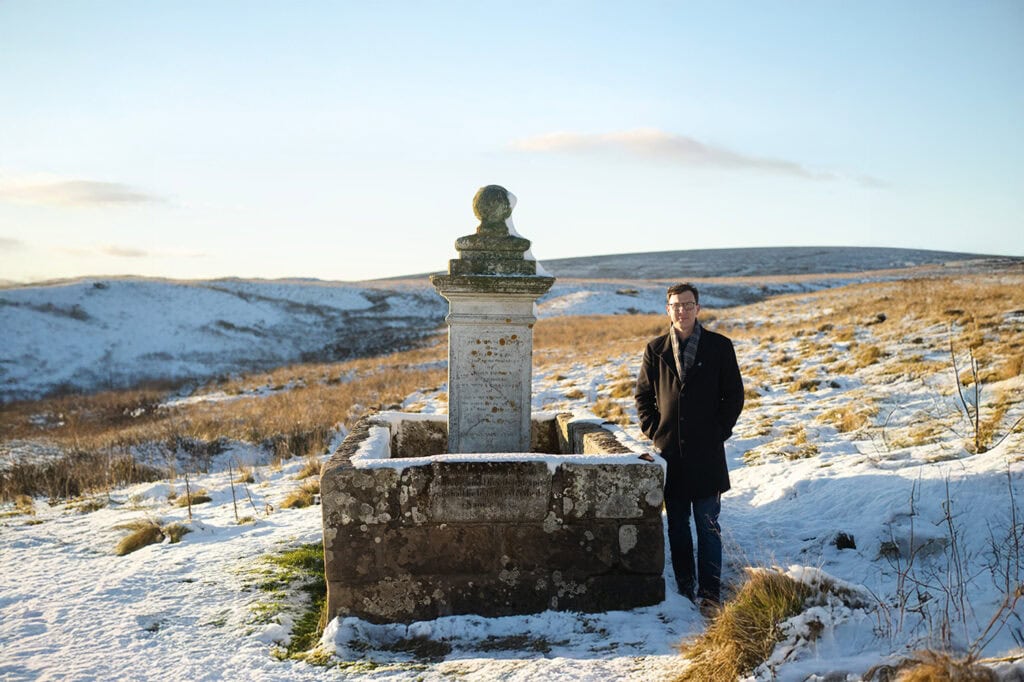
In late November of last year, on the hills above the remote village of Muirkirk in south-west Scotland, three figures picked their way through icy bogland. The purpose of their expedition was to locate a memorial erected to the memory of the martyr John Brown, who was shot on his doorstep by Charles II’s dragoons for his allegiance to the cause of Scotland’s National Covenant. The site was remote in 1685, when Brown was killed, and even now it is hard to reach, accessed by a winding lane and then by a rather overgrown track which ambles over the sodden moorland.
Whatever the difficulties of reaching the site of John Brown’s memorial, we were very glad to do so in pursuit of footage for a new Banner of Truth four-part video series, ‘The Covenanter Story’. The Covenanters were Scottish Christians of the seventeenth century whose commitment to the kingship of Christ in his church brought them into direct conflict with the British state in the persons of the Stuart kings, men who believed themselves rightful rulers not only of the state, but also of the Kirk (church) and the conscience of individual men and women.
The videos, which are now available for free on our YouTube channel, relate the stories of four men whose martyrdoms shed light on different stages of the Covenanter struggle: James Guthrie (d. 1661), Hugh M‘Kail (d. 1666), John Brown (d. 1685), and James Renwick (d. 1688).
John Brown’s death is particularly poignant, and that for several reasons. Unlike the other three men, Brown was not a pastor but an ‘ordinary’ Christian—a man who made his living, such as it was, as a ‘carrier’, an early form of postman. Unlike the other three, his death was not a public execution, but an extra-judicial killing ordered by the brutal commander John Graham of Claverhouse (1648–1689). Finally, Brown’s death was strikingly foretold by Alexander Peden, the ‘prophet of the Covenant,’ and at his wedding, no less. Jock Purves relates the circumstances:
[Peden] had married the Covenanter to Isabel Weir in 1682, and after the simple Puritan ceremony had said to Isabel, ‘Ye have a good man to be your husband, but ye will not enjoy him long; prize his company, and keep linen by you to be his winding sheet, for ye will need it when ye are not looking for it, and it will be a bloody one.’ A Covenanting wedding! The Covenanter’s deepest joys ever carried the shadow of the Cross.1Jock Purves, Fair Sunshine: Character Studies of the Scottish Covenanters (Edinburgh: Banner of Truth, 2003), p. 52.
To see the still-lonely spot where Peden’s prophecy was fulfilled, and Isabel Weir violently bereft of her husband, was a sombre privilege indeed.
The Covenanters: Much maligned and much neglected
Raised in the south of England, I first came across the Covenanters in the secular historian Neil Oliver’s 2008 television series ‘A History of Scotland’. Oliver’s sympathy for the men of the Covenant was, perhaps unsurprisingly, rather limited. It was easy for him to dress them in the garb of ‘fundamentalism’, men fanatically and irrationally devoted to ‘King Jesus’ (he practically spat those wonderful words out at times!)2The past three centuries have amply demonstrated the close connection of Enlightenment humanism to state-sponsored violence of the most grievous kinds. In relation to Neil Oliver, it ought to be noted that since the production of ‘A History of Scotland,’ he seems to have adopted a mellower tone towards the Covenanters, although he still regards them as ‘religious extremists.’ For a recent contribution from him on the topic, consult episode 52 of his ‘Love Letter to the British Isles’ podcast: https://www.youtube.com/watch?v=oU1NqMNF6x4 (accessed 9 December 2025).
This perspective on the Covenanters—the idea that they were unhinged religious zealots—first gained traction among their original enemies in church and state and persists to this day.
While we rightly reject this characterization, it must at least be conceded that Mr Oliver knows about the Covenanters. By contrast, very few within the evangelical church, including those who would describe themselves as ‘Reformed,’ have a working knowledge of these Christian witnesses. And this is a great shame, for they ‘belong to us,’ so to speak. Those faithful Covenanters who lived out a brave faith in the Lord Jesus Christ in evil days are our brothers and sisters. And while the Presbyterians among us have a special claim on their kinship, the fact is that all who desire to live a godly life in Christ Jesus may legitimately lay claim to them as spiritual ancestors. We confess the same essential faith that they did. More soberingly, we may soon find ourselves facing the same essential conflicts that they did. Let us learn from them with that in mind.
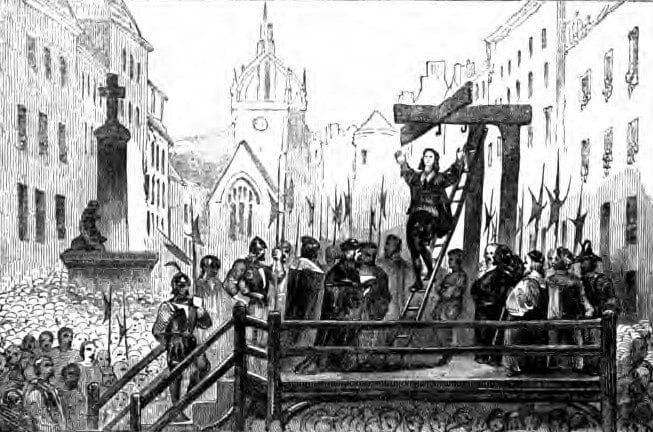
The Covenanters dared to uphold the sovereign claims of Christ in the face of the presumptuous counterclaims of the Stuart monarchs and their stooges in church and state. They paid the price in harassment, social ostracism, imprisonment, forfeiture of land and possessions, and forced exile and transportation to other lands. Thousands of them were killed: some in combat, others because of torture and harsh prison conditions, and others by execution, public or private. Thousands more were, like Isabel Weir, bereaved of loved ones.
A matter of stewardship
In producing these videos, our goal has not been primarily polemical. We are not seeking to defend the Covenanters in any systematic or thorough way from the claims of historians unfriendly to their aims and sceptical of their character or methods. There is certainly a place for such work, and readers interested in the cut-and-thrust of historical apologetics will find much that is still of value in J. K. Hewison’s remarkable two-volume study The Covenanters.3J. K. Hewison, The Covenanters (1908, repr. Edinburgh: Banner of Truth, 2019). Rather, our goal has been to introduce the outline of the Covenanter story, along with some choice highlights of Christian love, devotion, and sacrifice found in it, to a new audience. We wanted to provide an ‘on-ramp’, a user-friendly orientation to who the Covenanters were and why they still matter for us as Christians today. We hope, too, that the videos will signpost interested readers to books like Jock Purves’ Fair Sunshine and John Howie’s The Scots Worthies, which provide fuller accounts of great value for Christian instruction and encouragement.
As pressures increase on Christians in the Western world, may these videos serve the church by highlighting witnesses who, in an imperfect yet significant way, bore witness to the Lord Jesus Christ, the only one who may with full justice be called ‘the faithful witness’ (Rev. 1:5).
You can watch the videos here, and sign up to our emails (UK/World list or North America list) to learn more about our books and ministry.
Watch the first video:
Latest Articles
A Martyr’s Last Letter to His Wife February 11, 2026
In the first video of The Covenanter Story, which releases tomorrow, we tell the story of James Guthrie, the first great martyr of the Covenant. On June 1, the day he was executed for high treason, he coursed the following farewell letter to his wife: “My heart,— Being within a few hours to lay down […]
Neglecting the Soul January 26, 2026
The following article appeared in Issue 491–2 of The Banner of Truth Magazine (August–September 2004). How many times does the Bible tell us to watch our own hearts! Yet how often do Christians slip and fall for want of diligence in this very basic duty! Not for nothing does the Bible say: ‘He that ruleth […]