
Amy Carmichael: Times of Refreshing and Times of Trial
Iain H. Murray’s Amy Carmichael: Beauty for Ashes is a short retelling of the remarkable life of the Irish missionary to India. What follows is Chapter 4 of that title, ‘Hard Days and Golden Years.’
If there was any pattern to Amy Carmichael’s life it was of times of refreshing then of trials, of exhilarating ‘climbing’ then of walking in dark ravines. In part her explanation was that demonic activity follows the work of the Holy Spirit. As she quoted from George Bowen,
When Christianity assumes an aggressive attitude the first result is a great exhibition of Satanic power. Satan’s power to be manifested must be assaulted.1Overweights of Joy, p. 45.
Such an understanding does not come so readily to us who do not live, as she did, within sight of demon possession, or within hearing of tom-tom drums calling devotees to idols.
Shortly before Walker2This was the Rev. Thomas Walker (1859–1912), who together with his wife were valued fellow-labourers with Amy Carmichael. had left on his last mission, he had been sitting with Amy and others in deck chairs under the stars. ‘We had been talking’, she later wrote, of work and workers, and of those (to me) most wonderful women, who seemed perfectly self-reliant, needing no strong arm alongside. I remember how, suddenly startled at the bare thought of working alone, in the sense of all the burden of responsibility, I exclaimed that I never could do it. Mr Walker laughed. ‘Well, you don’t have to’, he said.3Frank Houghton, Amy Carmichael of Dohnavur: The Story of a Lover and her Beloved p. 174.
Amy was the weaker when her ‘strong arm’ died at the age of fifty-four. What she owed to Walker’s ‘courageous championship’ of the children’s work, ‘through its first very difficult years, no words can tell, nor can words tell how he is missed’.4Walker, p. ix. At times, as she faced her loss, she would need to say to herself, ‘Don’t give up, don’t be afraid: go on.’ Prayer for ‘fortitude’ entered her life.
There were unsympathetic neighbours who observed the work at Dohnavur who supposed that Amy would now be more vulnerable. One of these was a lawyer who, soon after Walker’s death, wrote with the demand that current work on the building of a wall around the compoundbe stopped, and that a half-built nursery should be pulled down. They were using ground, he claimed, to which they did not have legal title. ‘He had waited till Mr Walker’s death had left us, as he thought, defenceless, almost desolate, and sure to be easily cowed by threats of court trouble.’
The wall building had been prompted by the passage of a tiger through the compound at night; and the new nursery was necessitated by the growing numbers of children for whom Dohnavur had become home. Amy ignored the letter and heard nothing more of the threat.
The Dohnavur family of seventy children and grown-ups in 1906, had doubled itself by this date, and the need of more helpers was pressing. Mrs Catherine Carmichael was never able to return. She died on July 14, 1913. A few weeks earlier a letter from her to Amy began with the words, ‘My own most precious earthly possession’. While Amy did not lament her mother’s death—for no Christian death was to be ‘lamented’—in the days ahead she needed to preach to herself, ‘I must remind myself to live in the joy of those gone, not grovel in the sense of my loss.’
Mrs Carmichael had been a constant supporter and representative for Dohnavur in Britain. She acted as the home secretary to whom gifts could be sent, and helped to make her daughter’s books more widely known. In 1912 those books had been noted by Queen Mary, wife of King George V, who expressed her thanks for them.
While Amy was busy in 1913 writing Walker of Tinnevelly, there came the possibility of the loss of her closest female friend and helper, Ponnammal, who had been with her ever since, as a young widow, she had come to new life through Walker’s preaching. She now needed surgery for cancer and Amy went with her to a Salvation Army Hospital at Neyyoor for a period. In their absence from Dohnavur (forty-six miles away), and the absence of Mabel Wade who was on furlough, 70 of the children were ill. The need for more medical facilities at Dohnavur itself was evident. After much suffering, through which she was enabled to pass triumphantly, Ponnammal died in 1915, leaving her daughter to Amy’s care.
These same years were matched with much encouragement. New staff arrived who would be mainstays in years ahead. Walker’s former assistant and a convert of earlier years, Arul Dasan, became Amy’s helper; he was able to undertake many things, from the growing of vegetables to the taking of services. Women of Amy’s spirit who came to settle in the Dohnavur family included Frances Beath, Agnes and Edith Naish, and Frances Nosworthy. Of special joy to Amy was the way ‘the wind blew through us as a family’ in 1912. The occasion was the preaching visit of a visitor, R. T. Archibald, a man specially used of God in speaking to children. ‘There was’, writes Amy,
a true conviction of sin, true repentance, honest confession and a change of life that lasted. Not one child then converted went back. Some are mothers of families now, and some are our fellow workers here.5Gold Cord, p. 156.
Thirty were baptized in 1913.
A change in the financial support of the work was observable at this time. After several years when unsolicited gifts had been enough to cover expenses, there had come a surplus which could be laid aside. The outbreak of world war in August 1914 was to show the significance of this surplus. The British pound dwindled in value until, at one point, it fell to four shillings—less than a quarter of its pre-war value. The exchange rate soared, and so did prices. Now it cost fifteen times more to bring a child to Dohnavur from the nearest station. Rice, the most needed daily commodity, was similarly affected. Additional ground, which Amy had purchased not long before, became the more valuable as it produced food supplies under Arul Dasan’s care. ‘We have never lacked one good thing’, Amy could write; ‘and during the years of the war, people of the towns and villages began to say, “God is there”; for they could not account for what they saw except by saying that.’6Gold Cord, p. 140.
Amy could never settle down to an acceptance of the fact that there were so many thousands of Hindus and Muslims, accessible from Dohnavur yet living without any hope in Christ. She dreaded a dull acquiescence to the situation, and believed that a hindrance to God’s working might ‘be found in us’:
There may be weakness, compromise, lack of determination to keep the winning of souls to the front, the use of unconsecrated means, unsanctified ways of getting money, unconverted workers. There may be an absence of identification with the people for whose sake we are here, an unconscious aloofness not apostolic. Perhaps our love has cooled. Perhaps we know little of the power of the Holy Ghost, and hardly expect to see souls saved here and now, and are not broken down before the Lord because we see so few. God forgive us and make us more in earnest.7Overweights of Joy, p. 132.
Others at Dohnavur were to carry on the itinerant evangelism that Amy had followed in earlier years. But at times she herself continued to make visits to dark corners. No one was with her, save a young convert girl, when she faced Brahman leaders near their temple quarters. They laughed at her and declared, ‘You are alone, and you see how many we are. This is how the case stands all over India.’ There were other occasions when, with an element of disguise, she entered buildings shut to foreigners looking for children, or stood ‘by night in the doorway of the temple, with the sculptured pillars about us, monstrous in the gloom, and the lights glittering around the idol shrine where no alien foot may tread’.8Gold Cord, p. 293. From such scenes she could withdraw with a sense of defeat and ‘a haunting sense of impotence’.9I quote here from Gold Cord, p. 293, where she also comments, ‘It is a deadly mistake to underestimate Hinduism.’ Her efforts seemed like ‘a snow flake falling on the Great Pyramid, melting and vanishing as it touched the hot stone’. Then she would preach to herself,
Not to yield is all that matters. Failure or success as the world understands these words, is of no eternal account. To be able to stand steady in defeat is in itself a victory.10Gold by Moonlight (1935; reprint ed., London: SPCK,1960), p. 169. She was passing on to others what she had first said to herself.
But conversions continued. Not normally of a number at the same time, as happened in 1912, yet that occasion was not unique. One day a manwas mauled by a tiger and brought to Dohnavur for help. He was treated, recovered, converted and went back to his village to witness. This brought a call for preachers to go to them, and when two of the men from Dohnavur went they found a courtyard of people waiting who ‘would have listened all night’. Conversions, persecution and baptisms followed, and a little church was established which would stand firm.11Gold Cord, p. 334. Persecution was not to be dreaded, in Amy’s words, ‘It winnows the grain; we do not want a church of chaff.’
It is true that professed conversions did not always stand, and this was one of the greatest sorrows to be faced. But Amy would give no place to cynicism:
Better to be disappointed a thousand times— yes, and be deceived—than once miss a chance to help a soul. The love of God suffices for any disappointment, for any defeat. And in that love is the energy of faith and the very sap of hope.
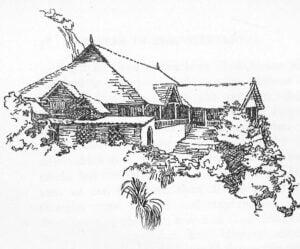
Through the years of the First World War, and on into the 1920s, the work at Dohnavur grew, more land was bought, and by 1923 there were thirty nurseries, each with a mother for the children. For escape from the heat in the hottest months, a Forest house was built up in the mountains, and another retreat was obtained at Joppa on the sea coast. These became prized holiday places for the children as well as refreshing places for Amy and her helpers. As well as workers from India, Britain and Ireland, others would come from Australia, New Zealand and Canada.
By 1923, Amy, who had been long accustomed to ‘think in terms of bullock carts, not motors’, acceded to the need to change the bullock-bandy for a Ford car. It was a valuable addition.12She has a chapter on ‘The Ford Car’ in Tables in the Wilderness (Madras: SPCK, 1923), a small book on how financial needs were being met.
Commonly Amy was given hope of what God might do before she saw any fulfilment. One such hope grew out of her concern for boys. Not at first did she recognize that male infants were also acquired by the temple priests for evil purposes. They were wanted, for instance, to be acolytes attending the gods in processions,13This may sound harmless enough until it is remembered, as Elisabeth Elliot writes: Amy ‘believed that the gods of India, as described by their aggressive or seductive images, were satanic, and they that made them were “like unto them”.’ Chance to Die, p. 243. to act in immoral plays, or to become the property of homosexuals. From 1912 she made this a matter of prayer. Although she asked God to take her burden about it away, or show her what to do, she had to wait. Then late one evening in
January 1918 an event made action unavoidable. A needy child was handed in, and was put in a nursery before it was discovered that it was a boy. By 1926 there was to be a boys’ compound with some seventy to eighty children.
Another hope, and seemingly the more difficult for fulfilment, concerned the need for a hospital and doctors at Dohnavur. As already noted, when there was serious illness the help needed was not at hand. There were cases such as Lulla’s, in 1912, when assistance had to be called from elsewhere only to arrive too late. Amy has written of how her hope became a very definite prayer for eight of them one evening, January 30, 1921, as they stood together in the sunset, looking over the plain. ‘We could see clusters of trees’, she recalled,
each telling of a village; to east and south and north we saw temple towers; behind one little conical hill lay a small fortress of Islam, a place of many frustrations. And we wondered why there was no medical mission in this part of British India specially bent on reaching those who are practically unaffected by the gospel.
This vision was not for medicine as an alternative to evangelism, but for doctors who would simultaneously be witnesses to the needy. Three years later Dohnavur came to have three medical doctors. They were May Powell, and the Neill family, in which both parents were physicians. In this family there were also a daughter and a son, Stephen, who had just left Cambridge where he was a fellow of Trinity College. There had hardly been such a distinguished addition to the work as the Neill family. Amy may have had doubts how easily a group of this weight and influence as the Neills would fit into work which she had led since Walker’s death. As it was, the medical work went forward, first in sheds, then later, in a complete hospital, opened as ‘the Place of Heavenly Healing’. This, however, was without the presence of any of the Neills. The Neill parents had some difference with Amy over where a new hospital should be built, whether as part of the Dohnavur compound or elsewhere. They had only stayed six months. But Stephen Neill remained and it was with him that the more serious disagreement occurred.
Although not yet ordained in the ministry of the Church of England, his parents believed that, with a Cambridge education behind him, and having learned Tamil in an astonishing six months, Stephen was better qualified than Amy to lead and supervise Christian instruction.
But Dohnavur was not Cambridge, and the difference was not merely in the appearance of things. The whole approach to the Bible in Britain’s university world had undergone a major change. Some, including Neill, thought that a change of belief over the trustworthiness of Scripture could be accommodated within ‘a new type of Evangelicalism’.14Stephen Neill, Anglicanism (London: Penguin Books, 1960), p. 400. His subsequent history shows that this was his view, and there can be little doubt that it was already being formed when he came to Dohnavur. In his mother’s opinion, harmony between him and Amy was impaired because Amy had been influenced by ‘strong Plymouth Brethren nonconformism’.15Chance to Die, p. 269. Whatever the pejorative name was meant to cover, it had to include belief in the full inspiration of Scripture, or ‘Fundamentalism’, as that belief was now being classified.
What was actually discussed between Stephen Neill and Amy, now fifty-eight, has not been recorded. The twenty-five-year old graduate may have reminded her that the Church Missionary Society had declined to make the full inspiration of Scripture a necessary qualification for their missionaries. The presence of a ‘new evangelicalism’ had come fully into the open in 1922 when H. E. Fox and the Bible League had asked missionary societies not to send out to the mission field ‘any who deny or doubt that every writing of the Old and New Testaments is Godbreathed, through men who spoke from God, being moved by the Holy Ghost’.16Quoted by Andrew Atherstone in Evangelicalism and Fundamentalism in the United Kingdom During the Twentieth Century, eds. D. Bebbington and D. C. Jones (Oxford Universtity Press, 2013), p. 62. The CMS offered no such assurance. This was not irrelevant for, as already noted, the society owned the original Dohnavur property. On July 6, 1925, after painful, sleepless nights, Amy withdrew from the Church of England Zenana MissionarySociety which was linked with CMS. ‘A dreadful time of distress’, she wrote in her diary. ‘Never such known here before.’ She believed that ‘the spiritual fortunes of the work hung by a thread’.17Chance to Die, p. 268. In August she wrote to a friend, ‘I do trust that no one will ever know how difficult things are now.’
The crisis continued until November 1925 when Stephen Neill’s continuance became impossible. On the 28th of that month Amy noted, ‘One of the very saddest nights of my life.’ The next day he was asked to leave.
Amy makes no reference at all to the Neills in her history of Dohnavur as given in Gold Cord, and the same silence is preserved in the Houghton biography. In this there was kindness on her part, and perhaps an element of churchmanship on the part of Houghton for, by the time his biography of Amy Carmichael was published, Stephen Neill was a bishop. Years later Elisabeth Elliot was right to break the silence, for the point at issue affected not only Dohnavur but the whole scene of world missions as I will seek to point out in chapter 7 below. It is arguable that Dohnavur was to retain the old evangelical orthodoxy after Amy’s death because there was no supervisory direction from London. The CMS allowed the mission station which they had originated, and which she had built up, to become independent. It would be a misreading of this trouble to attribute it to any bias on Amy’s part against the Church of England. Numbers of her friends belonged to that denomination. When the crisis was over, a new building became the place of worship in 1927. Without pictures, stained glass windows, or symbols, it became the place for three services every Sunday, one English and two Tamil. The Bishop of Tinnevelly was asked to take part in the opening. Explaining her thinking, Amy wrote:
When the local bishop has been a friend whose coming would help towards the spiritual life of our company, we have asked him to come to us from time to time, and when he was not we have not.
After Neill became Bishop of Tinnevelly in 1939 he was not invited to Dohnavur.
In 1927 what had been formally known as the ‘Dohnavur Nurseries’ was formed on a legal basis as the Dohnavur Fellowship. The stated aim was,
To save children in moral danger; to train them to serve others; to succour the desolate and the suffering; to do anything that may be shown to be the will of our Heavenly Father, in order to make His love known, especially to the people of India.
A council made up of eight of Amy’s best helpers was formed, with no distinction made on grounds of nationality. Amy continued in the overall leadership of the work she had been given to do. The partings thus led to a real consolidation. Harmony had to rest on foundational beliefs. In the words of Elisabeth Ellliot:
Three things mattered: the verbal inspiration of Scripture, the power of God to deal with His enemy, and loyalty to one another.
From this date there came a more careful scrutiny of candidates. A series of twenty-five questions would be put to volunteers, intended to avoid future disappointments, and to show that
Dohnavur would not be a comfortable place for all comers. These questions included:
Samuel Rutherford said that there are some who would have Christ cheap, Christ ‘without the cross. But the price will not come down.’ Will you pay the price to live a crucified life?
Besides the Bible, which three or four books have helped you the most? Besides reading books, what activity refreshes you best when tired?18Amy was deeply persuaded of the importance of Christian literature. ‘Send books’, she would write home. The biographies of such missionaries as Henry Martyn and Adoniram Judson she regarded as ‘a sort of standing dose of mental and spiritual quinine’. She had no time for fiction except in her later invalid days when she enjoyed the stories of John Buchan.
The late 1920s Amy came to regard as something like golden years. The staff situation had been greatly helped by the coming of two brothers, Murray Webb-Peploe,19Katharine Makower, Follow My Leader: A biography of Murray Webb-Peploe including his years of service with Amy Carmichael at Dohnavur (Eastbourne: Kingsway, 1984). along with his brother Godfrey, men of the same heartbeat as Amy. Murray, a doctor, took the leadership in the hospital, assisted by May Powell, while Godfrey met the urgent need for someone to head the work among the boys. It was a role for which he was ideally suited.
The addition of people and buildings did not mean as much to Amy as the evidence of the on-going work of God in their midst. Her dream that the babies and infant girls of earlier years would become ‘mothers’ and nurses of the next generation was being fulfilled. She saw that the long-term future lay with Indian leadership. For the present her plan was for May Powell to become the leader on the women’s side, and the Webb-Peploe brothers on the men’s.
The addition of people and buildings did not mean as much to Amy as the evidence of the on-going work of God in their midst.
I have sought in this chapter to highlight some leading events from two decades. The danger in doing so is that the humdrum events of ordinary life are too much out of view. What Amy wrote of Walker was true of herself. She was
called to live a holy life—not in the ease of religious seclusion, nor in the midst of those rare heroic circumstances which emphasize the glory side of existence, but along the dusty levels of commonplace ways.
Other sentences in the Foreword to her biography of Walker speak of the kind of daily routine in which she worked:
Always there were hindrances, just simple and ordinary: the crush of other duties around one, the impossibility of assured quiet for even an hour at a stretch, the lack of invigorating influences—for who finds the Plains of India invigorating?
Then she added words which epitomize the story of her life, ‘But I have been splendidly helped.’
Her books were a vital feature of this whole period. Between Things as They Are in 1903 to Gold Cord in 1932, some seventeen other items had come from her pen, of various shapes and sizes, Walker of Tinnevelly at 458 pages being the largest. The necessity for the help of those who would pray had initiated this flow of literature but it also came to have another purpose. Initially, while Robert Wilson of Keswick was alive,20He had died in 1905, and was buried in the small Quaker burial ground in the fields above his home at Broughton Grange. A simple stone bears the words, ‘All one in Christ Jesus’ (Gal. 3:28). Dohnavur was a additional financial support was not as urgent as it would later become, but the books brought a world-wide circle of friends, and by 1923 there were seven volunteer secretaries representing Dohnavur. Irene Streeter of Oxford followed Catherine Carmichael in that role in England, others were in Co. Wicklow, Ireland; Dunlop, Scotland; Melbourne, Australia; Christ Church, New Zealand; Albany, USA; Ontario, Canada. All were asked ‘to restrain from asking for gifts’ and there was to be ‘no collection at any meeting’.21Tables in the Wilderness, p. 153. This book of 151 pages details something of the financial side of the work. Dohnavur was not a ‘faith’ mission in the sense of not making the needs of the work known, but Amy was cautious and endorsed the words of Hudson Taylor: ‘The apostolic plan was not to raise ways and means but to go and do the work, trusting his promise who said, “Seek ye first the kingdom of God and his righteousness and all these things shall be added unto you.”’
The work at Dohnavur inevitably brought visitors. In 1910 Amy could speak of as many as 65 unexpected guests arriving. Her correspondents came to be a much larger number, with letters arriving from many more countries than those named above.
If some of her correspondents thought of Dohnavur as ‘a kind of Garden of Eden without the serpent’, she was quick to disabuse them.22Houghton, p. 257. Visitors to Dohnavur might admire the harmony there but, as we have seen, times of strife and tension were not unknown, as Walker would say, ‘The perfect church, not having spot or blemish or any such thing is yet to come.’ Heaven is not yet.
Amy Carmichael: Beauty for Ashes
Amy Carmichael
Beauty for Ashes
Description
Endorsements ‘This is a love story of the noblest kind. It is an enriching consideration of a woman’s relentless love for her Saviour, her Bible, her friends, and most uniquely, her love for lost, suffering and desperate sinners – to whom she gave her life. Such devotion as hers seems so distant. Reading this brief […]
Featured Photo (visible when post is shared on social media) by Nadiia Ploshchenko 🇺🇦 on Unsplash
Latest Articles
Pitfalls in Preaching: A Letter on Application September 30, 2026
The following letter was published in the December 2025 issue of the Banner Magazine. It is published here at the request of a reader who found it helpful, in the hope that its counsel might be blessed to others also. You can also listen to a reading of this letter on the Banner Podcast. Dear […]
The God Who Makes Bitter Things Sweet July 31, 2026
The Israelites had just walked between the walls of the water of the Red Sea and watched as the Lord washed away the whole Egyptian army. They sang a song of triumph on the far shore of the sea, rejoicing in the fear that had fallen on the surrounding nations (Ex. 15:14-16) and looking forward […]