
Why Publish Peck?: Our Introduction to His Writings
The following is our ‘Publisher’s Introduction’ to the Writings of Thomas E. Peck, provided by Iain H. Murray.
In the small cemetery of Union Theological Seminary, beside a narrow road in the heart of rural Virginia, the earthly remains of Thomas Ephraim Peck were buried in the first week of October 1893. Two years later the first of these three volumes of his collected writings was published, and the set was complete by 1897. Since then the world has moved on, just as Union Seminary itself has moved to Richmond, the state capitol of Virginia, and, except for a few, Peck’s writings are as little known as that quiet country grave at Hampden-Sydney. In part the explanation lies in their rarity, for the original print run was probably not large and until the present there has been no reprint. A more fundamental reason, however, lies in the fact that even by the time of his death the convictions which he represented were losing ground both among the Southern Presbyterians to which he belonged and among evangelicals more generally. To read Peck today is to realise how much has changed and to conclude that either he or many contemporary spokesmen for Christianity are far astray from Scripture.
Born in 1822, Peck was brought up by his widowed mother in Columbia, South Carolina, where he graduated at the College of that state at the age of eighteen. It was here, also, that he came under the saving power of the gospel through James Henley Thornwell and by the latter he was prepared for the work of the Christian ministry. Such was Thornwell’s esteem for his pupil that, when he was delayed in taking up the pastorate of the important Second Church of Baltimore, he sent Peck, who was not yet twenty-four years old, to fill its pulpit in the meantime. Unexpectedly Thornwell was not released from Columbia and the Baltimore congregation were happy to appoint his deputy to the charge in 1846. One of the finest of Thornwell’s surviving letters was one of encouragement written to ‘My Dear Thomas’ at Baltimore in 1848: ‘I have never entertained a doubt that you were the Lord’s instrument, to accomplish the Lord’s work, in the sphere of your labours … Effective sermons are the offspring of study, of discipline, of prayer, and especially of the unction of the Holy Ghost.’ But Peck was evidently finding that his attainments in preaching fell far short of his desires and Thornwell, often regarded as the preacher par excellence, consoled him with these words, ‘My own performances in this way fill me with disgust. I have never made, much less preached, a SERMON in my life; and I am beginning to despair of ever being able to do it.’1B. M. Palmer, The Life and Letters of James Henley Thornwell (1875, repr., Edinburgh: Banner of Truth, 1974), pp. 314-5. Among those who have noted these words is Martyn Lloyd-Jones in Preaching and Preachers (London: Hodder and Stoughton, 1971), p. 99.
In a fuller biographical account which the reader will find in the third volume of this set, C. R. Vaughan speaks of Peck’s years in the Second Church of Baltimore as years of slow progress and of difficulty. No doubt this was preparatory to his future greater usefulness. Few men have safely attained to spiritual leadership without a preparatory period of humbling. During this period he edited with his friend, Dr Stuart Robinson, the Presbyterian Critic and Monthly Review (1855-56).2It is characteristic of Peck that he does not mention this fact in reviewing Robinson’s labours below. See below, p. 364 . For a longer period in later years he was to be an associate editor of the Southern Presbyterian Review.
In 1857, when Peck was expecting to move to Lynchburg, Virginia, the Baltimore Presbytery directed him to remain but to remove to the charge of the large Central Church left vacant by the departure of Stuart Robinson. Thus, as Vaughan says, ‘Peck, suppressing his personal preferences, assumed the care of a large and important field in the same city in which he had spent twelve years of discouraging work.’
Leaving Baltimore in 1860, Peck took up the great work of his life at Union Theological Seminary. This Seminary, the first in the South, had arisen as a department of the College of Hampden-Sydney in 1823-24. Soon the two became separate institutions and the Seminary gained its own buildings in the same location with John Holt Rice as its first president.3It is to be hoped that the splendid Memoir of the Rev. John H. Rice by W. Maxwell (Philadelphia: J. Wetham, 1835) may yet be reprinted. The death of Rice in 1831 slowed the growth of the work but it increased again notably after the appointment in 1853 of Robert Lewis Dabney as professor of Church History and Government. The next year Benjamin M. Smith was elected professor of Oriental Literature. By 1860, when student numbers stood at thirty-nine, it was thought desirable to transfer Dabney to the chair of Theology, leaving Peck to take the chair of Church History. After the devastation of the Civil War, from which several of the students never returned,4The lives of two of these students have recently been reprinted, Sketches of the Life of Hugh A. White and of Dabney Carr Harrison, William S. White and William J. Hoge (Harrisonburg, Va.: Sprinkle Publications, 1997). this same division of duties between Peck and Dabney continued until the latter’s removal to Texas in 1883. Thereafter, Peck succeeded Dabney as professor of Theology, and continued in that post through the last ten years of his life until his death at the age of seventy-three. Dabney outlived him and it is indicative of the abiding affection which existed between the men who taught at Union that he directed that on his death his body was to be taken back to Hampden-Sydney. ‘He loved the homely little cemetery,’ his biographer writes, which contained the dust of friends and of three children.5T. C. Johnson, Life and Letters of Robert Lewis Dabney (1903; repr., Edinburgh: Banner of Truth, 1977), p. 5 25.
In speaking of ‘the great men of the past,’ Ernest Trice Thompson, in his monumental history of the Presbyterians of the South, lists them at one point in this order: ‘Thornwell, Dabney, Palmer, Peck . . .’6E. T. Thompson, Presbyterians in the South, vol. 3 (Richmond: John Knox Press, 1973), p. 283. In the last thirty years the memory of the first three has begun to be revived with the republication of their works and biographies.7In addition to the reprints of their biographies, Banner of Truth have reissued The Collected Writings of J. H. Thornwell, 4 vols. (1974); and R. L. Dabney: On Preaching (1979), Systematic Theology (1985), and Discussions: Evangelical and Theological, 3 vols. (1982). It is fitting that these volumes of Peck should also appear. C. R. Vaughan, his successor at Union, said of him: ‘As an expositor of truth, as an exegete of Scripture, as a philosophic student of history, he was probably without a rival in his day.’8See vol. 3 of this set, p. 17. C. R. Vaughan’s own volume, The Gifts of the Holy Spirit (1894; repr., Edinburgh: Banner of Truth, 197 5), is an outstanding example of teaching of the same order. Peck’s mother survived him, and to her Palmer wrote of her son:
He was so strong in his convictions, so unswerving in fidelity to truth, so powerful in his humility before God to prevail in prayer, so wise and considerate in counsel, that he always seemed a strong staff on which to lean in time of trouble and of peril to the Church. On these public grounds I always admired and loved him; while a closer personal affection for him grew out of the intercourse of the years long since gone by.9T. C. Johnson, Life and Letters of Benjamin Morgan Palmer (1906; repr. , Edinburgh: Banner of Truth, 1987), p. 586. Johnson, who succeeded Peck at Union Seminary (I 913-30), did splendid work in conserving the records of the Southern Presbyterians.
In a chapter entitled ‘Some Presbyterian Leaders of Our Own Time’, Henry Alexander White wrote: ‘First among these let us name a beloved instructor, that godly teaching elder, Thomas E . Peck.’10H. A. White, Southern Presbyterian Leaders (New York: Neale Publishing, 1911), p. 454. Despite such tributes it was only with difficulty that T. C. Johnson brought together anything that began to approach the worth of the man in these volumes. This is reflected in the original title given to this set, Miscellanies of Thomas E. Peck. It was a fitting description, for the volumes do not contain ‘works’ prepared by the author for publication. Many items included were indeed written for the press and gathered by Johnson from various journals, but they were not composed with any sequence in view. Other material is from surviving manuscripts of his speeches or (in volume 3) from ‘notes’ used in the seminary class or in the pulpit.11Manuscripts which remain unpublished are preserved in the Peck Collection at the Presbyterian Historical Foundation, Montreat, N. C. C. R. Vaughan observed the difficulty in the sketch of Peck’s life which originally appeared before this set was published: ‘It was a fault with him, as it is with other gifted men, that he published so little.’
Bearing this in mind the present publishers considered a reprint of only parts of these three volumes. We decided against that course for the very good reason that, while there is undoubtedly an unevenness in some of the material, striking and suggestive insights turn up repeatedly in sections where they might least be expected. All in all, readers will prefer to make their own decision on what remains of abiding value.
In view of Peck’s identification with theology which is already more readily available in the writings of Thornwell and Dabney, it may also be queried whether Peck’s writings contain anything of distinctive importance which merit their republication. We believe that they do and that it would be a mistake to suppose that to have read one of these men is to have read them all. While representing a common ethos they thought too much of the need for independence in judgment not to be in occasional disagreement. Dr Thompson illustrates this by a subject keenly debated after the Civil War, namely, whether or not black congregations should be encouraged to meet separately and independently of the white, contrary to previous practice. Dabney was for that proposal. Peck was against and asked:
Why . .. should the freedmen who cultivate our soil, serve us in our houses, cook our food and nurse our children be put into a church by themselves? … If the freedmen should, all of them, become Presbyterian in faith and order we ought to welcome them all into our pale. This distinction of race, be it remembered, has been expressly abolished by Christ.12Presbyterians in the South, vol. 2, p. 214.
One of Peck’s arguments against the separation proposed brings out a prominent aspect in his thinking. He pointed out that the black population constituted ‘above all others’ the poor of the land and asked, ‘Are we prepared to say that these poor shall be excluded from our pale?’ This was driven home with the assertion, ‘I have no doubt that one great cause of the little progress made by the Presbyterian Church in Virginia is its neglect of the poor, both white and black.’ In harmony with this view are two sermons in this volume and his address on ‘Systematic Beneficence’ which led to the Presbytery of Baltimore reminding its congregations that giving is ‘an act of religious worship . .. an ordinance of God as much as prayer, or preaching or singing.’13Ibid., vol. 1, p. 526. In part out of the same concern Peck was a leader in the endeavour to have the office of the deacon restored to its full and proper function in the Presbyterian churches where too often ‘it remained comparatively unimportant.’14Ibid., vol. 2, p. 420. This attitude existed, Peck and others argued, because the scriptural orders of presbyter and deacon were confused.
It was on debate on the same subject on another occasion that we get a glimpse of what Vaughan calls Peck’s ‘keen sense of humor’. In a General Assembly debate in 1868 a committee chaired by Peck put forward the recommendation that the use of a hat in taking up the collection in Sunday services should be discontinued. A minister from North Carolina expressed strong opposition to such a departure from custom and, holding up his own hat (a fine glossy beaver) demanded, ‘The people are accustomed to the use of the hat. It is endeared to them by familiarity and habit. What would you substitute in place of it?’ ‘I would remind our brother,’ Peck responded, ‘that it is not always such a hat as he held up to view that is carried around in raising a collection. Sometimes it is an old, greasy slouch.’15Ibid., vol. 2, p. 427n.
Given such a stand-point it might be thought that Peck would have supported the popular practice of teaching that Christians should all tithe. But Scripture, he believed, did not support that conclusion, and his treatment in this volume of ‘The Moral Obligation of the Tithe’ is a good example of an important argument which is not readily to be found elsewhere. Another example of his ability to take up subjects not to be found in the works of his better-known colleagues has to do with revival. The whole Old-School of men to which he belonged believed in outpourings of the Spirit at special epochs in history. One such revival, affecting wide areas, had occurred in Hampden-Sydney itself in 1787. But too often the belief was assumed rather than clearly set out as Peck does on ‘Revivals of Religion’ in this volume.
Some parts of these volumes will be seen only as expressing the opinions of a past age and the denominational loyalties of the author. No doubt there are instances where that is true, yet part of the value of these volumes is the pervasive scriptural seriousness which forces the reader to question whether it is we who may be adrift from the truth. As an instructor Peck certainly wanted nothing more than to have his pupils bring all to the test of Scripture. No one left Union Seminary in his day without being impressed with the conviction that all success and popularity gained without the sanction of the word of Christ can ultimately only bring disaster.
Many of the subjects in these pages remain critically relevant to the church at the present time. They include such issues as those of worship, of church and state, of the moral law and of Roman Catholicism. Unlike too many of the professors of the present day, Peck does not write as an academic. He would have agreed entirely with the words of John Milne, a Scottish contemporary, who wrote, ‘The Church’s danger ever has been to substitute a ministry of the intellect for a ministry of the Spirit: to confide in the human instead of the superhuman.’16Horatius Bonar, Life of the Rev. John Milne of Perth (London: Nisbet, 1868), p. 102.
Peck’s writings pass on to us the same message which Thornwell wrote to him as a young minister in 1848, ‘Have faith in God; aim singly at His glory.’ A little anecdote which Vaughan gives us suggests that Peck kept that aim before him. When the Civil War had convulsed the nation in calamities, a Virginian in another part of the state met someone from the neighbourhood of the seminary and asked for news. The reply he got was long remembered: ‘Well,’ answered the person from Hampden-Sydney, ‘Dr Dabney is fighting the Yankees, Dr Smith is hunting for provisions, and Dr Peck is trusting in God.’ Whether we agree with Peck in all things or not, a Christian can hardly rise from his writings without wishing for more of that same spirit, to be kept in the same steadfastness to the end.
IAIN H. MURRAY
3 Murrayfield Road
Edinburgh
October 1998
Buy the Writings of Thomas E. Peck
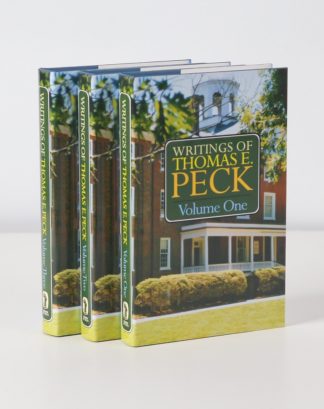
The Writings of Thomas Peck
3 Volume Set: Selected and Arranged by T.C. Johnson
Description
Book Description As a teacher, Peck was in the front rank. ‘As an expositor of truth, as an exegete of Scripture,’ his successor C.R. Vaughan believed, ‘he was probably without a rival in his day.’ But it was not mere teachers that he laboured to prepare for the gospel ministry but rather men ‘with a […]
Latest Articles
The God Who Makes Bitter Things Sweet 31 July 2026
The Israelites had just walked between the walls of the water of the Red Sea and watched as the Lord washed away the whole Egyptian army. They sang a song of triumph on the far shore of the sea, rejoicing in the fear that had fallen on the surrounding nations (Ex. 15:14-16) and looking forward […]
In the Christian Life, There is No Escape from Divine Chastisement 7 July 2026
The fifth of six posts containing the substance of teaching given by Albert N. Martin at the 1984 Banner Youth Conference, presenting a basic biblical theology of the Christian life. There is no escape from divine chastisement as an integral factor in the Christian life. The author of Hebrews underlines this point: ‘You have forgotten […]