
‘Against Hastening to Remove from Our Post of Duty’ – C. H. Spurgeon
Spurgeon’s Pastoral Wisdom, a selection of C. H. Spurgeon’s articles bearing on church life and pastoral ministry compiled by Geoff Chang, is soon to be released. Over the next three Mondays we’ll post excerpts which give a flavour of the great biblical and practical wisdom contained in this new volume. The first of these, ‘Against Hastening to Remove from Our Post of Duty,’ appeared in the Sword and Trowel magazine in July 1880:
He was a wise man who said, ‘The roundest peg seldom fits into the roundest hole without some paring.’ There is no position in life which, at the first, has not something irksome and trying about it. Newcomers cannot expect to feel at home at once. We remember our first wretched night at a school where we afterwards became supremely happy. Well do we recollect the misery of the first few months of a calling which we afterwards valued and enjoyed. Our mind was sorely depressed on first coming into that sphere in London, which has since been the delight of our life. Let no man, therefore, when he at first commences work in any place, feel at all discouraged by the uneasiness which may come over him. It is natural that he should feel strange in a new position. The burden is not yet adapted to the shoulder, and the shoulder is not yet hardened to the load. While feeling the irksomeness of a fresh position, do not be so foolish as to throw it up. Wait a little while, and time will work wonders. You will yet take pleasure in the very things which are now the source of discomfort. The very worst thing will be to hasten away and make a change, for the change will only bring trial in a fresh form, and you will endure afresh the evils which you have already almost mastered. The time which you have already spent at your new place will be lost, and the same weary first steps will have to be taken upon another ladder. Besides, you may readily leap out of the frying pan into the fire. Change has charms to some men, but among its roses they find abundant thorns.
Has the minister just entered upon a fresh sphere, and does he miss the affectionate warmth of his old acquaintances? Does he find his new people strange and singular? Do they appear cold and distant? Let him persevere, and all this will wear off, and he will come to love the very people to whom he now feels an aversion, and find his best helpers among those who now seem to be utterly indifferent to him. The call of Providence has brought him where he is, and he must not venture to leave because of inconveniences: often it will be his wisdom to regard these as a part of the tokens that he is in the right way, for the appointed path is seldom easy to the feet.
Has our young friend commenced teaching a class in the Sunday-school, and does she find it far less pleasant work than she imagined? Are the children wild and careless and inattentive, and does her own power of teaching appear to be smaller than she hoped? Let her give double application to her holy toil, and she will come to love it. Should she leave it, she may incur the blame of those who put their hands to the plough and look back. The ice has been already broken; the edge has been taken off from the difficulty; let her persevere, and all will be well.
There is no position in this world without its disadvantages. We may be perpetually on the move to our continual disquiet, and each move may bring us under the same, or even greater, disadvantages. We remember a Scotch story of an unlucky family who attributed all their misfortunes to their house being haunted by mischievous spirits, known to our northern countrymen as ‘brownies.’ These superstitious individuals became at length desperate; nothing prospered in house or field, they would therefore pack up all and begone from a spot so mysteriously infested. All the household goods were loaded up, and the husband and the ‘gude wife’ and the bairns were all flitting, when one of them cried out, ‘Brownie is in the churn. Brownie is flitting, too.’ Just so, the matters which hinder a man’s success are generally in himself, and will move with him; and wherein it is not so, he may yet be sure that if by change of place he avoids one set of brownies, he will find another awaiting him. There is bran in all meal, and there are dregs in all wine. All roads must at times be rough, and all seas must be tossed with tempest. To fly from trouble will need long wings, and to escape discomfort will require more than a magician’s skill.
It is wiser to ‘bear the ills we have, than fly to others that we know not of.’ It is probable that our present condition is the best possible for us; no other form of trial would be preferable. What right have we to suspect the wisdom and the goodness of God in placing us where we are? It will be far more prudent to mistrust our own judgment when it leads us to murmuring and discontent. Occasionally, it may be prudent to remove, or to change one’s form of Christian service; but this must be done thoughtfully, prayerfully, and with a supreme regard to the glory of God, rather than out of respect to our own feelings. A tree that is often transplanted will make but little growth, and bear but slender fruit. A man who is ‘everything by turns, and nothing long,’ will be a sort of ‘Jack of all trades, and master of none.’ An increase of spiritual strength by greater communion with God, and a more resolute determination to glorify him in every possible way, will usually conquer difficulties and win success. An extremely hard substance in the world may be cut by something harder: even the adamant can be forced to yield. Double force will make that easy, which now seems impossible. Do not, therefore, change the work, but change yourself. Attempt no other alteration till a distinct improvement in your own self has resolutely been carried out.
We speak thus because we believe that many are discouraged at the outset of a career which, if they could see its end, would fill them with thankfulness; and Satan raises these discouragements to tempt them to leave a position in which they may damage his kingdom and glorify Christ. Courage, dear friend, you have a great Helper; look to the strong for strength. Say with Nehemiah, ‘Should such a man as I flee?’ Who are you that everything should be made smooth for your feet? Are you such a little babe in grace that only the slightest tasks should be allotted to you? Be a man, and play the man. Resolve that even at this present, and where you now are, you will set up the standard, and hold the fort. Many are the instances in which men have commenced their life-work under every possible disadvantage, and for months, and even years, they have seemed to make no headway whatsoever, and yet they have ultimately triumphed, and have come to bless the providence which called them into a place so well adapted for their gifts. It would have been their worst calamity if, under a fit of despondency, they had changed their station or relinquished their vocation. The church would have been the poorer, the world would have been the darker, and themselves the feebler, if they had shifted at the first even to the most promising spheres which tempted them. That rock on which they stood, and mourned the hardness of the soil, was more full of the elements of fruitfulness than the softer soil at a little distance, which invited them to leave. Tarrying where they were, exercising indomitable perseverance, they have softened the granite, cultured it into fertility, and reaped a golden harvest. He is the greatest man who achieves success where stronger men might have failed. If we desire to glorify God, we must not select the comfortable positions and the hopeful fields; it is best to make no selection, but to yield our own will to the will of God altogether. The hole is round enough, it will be difficult to make it any rounder; the proper plan is to round ourselves. If we will but adapt ourselves to our position, the position will adapt itself to us.
It may be that these lines will furnish counsel to a brother whose choice now lies between being a rolling stone and a pillar in the house of our God. To turn tail under present pressure may be the beginning of a cowardly career, neither honourable to God nor to man: to stand fast at this distressing juncture may be the commencement of an established position of supreme usefulness and honour.
Sign up for the Waitlist:
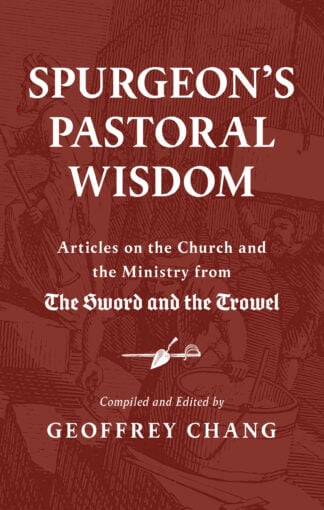
Spurgeon’s Pastoral Wisdom
Articles on the Church and the Ministry from The Sword and the Trowel
Description
Charles Haddon Spurgeon (1834–1892) was the famous pastor of the Metropolitan Tabernacle in London in the nineteenth century. Under his preaching, the once-dying church was revived and became an engine for evangelism, pastoral training, missions, and church planting. But Spurgeon wanted to see more than just his church thriving. He had a heart to see […]
Featured image (visible when post shared on social media) is a detail from an Unsplash image by Jon Tyson.
Latest Articles
Reading the Psalms: A New Resource 12 October 2026
As Christians we believe that all Scripture is God-breathed and useful for teaching, rebuking, correcting and training in righteousness so that the man of God may be thoroughly equipped for every good work (2 Tim. 3:16), but that doesn’t mean that there aren’t particular books and sections of Scripture that we love even more than […]
Pitfalls in Preaching: A Letter on Application 30 September 2026
The following letter was published in the December 2025 issue of the Banner Magazine. It is published here at the request of a reader who found it helpful, in the hope that its counsel might be blessed to others also. You can also listen to a reading of this letter on the Banner Podcast. Dear […]