
Dogmatists Against Dogma
The following excerpt is from James Walker’s The Theology and Theologians of Scotland, which we have just typeset and republished in a clothbound edition. Walker is here responding to the criticism of Scottish Christianity which faults it for being too doctrinal:
‘Then, again, I think the idea has taken possession of many in our day, that Scotch religion is a religion of speculative dogma, with little in it of the personal Christ. Now it seems to me there is a great deal said at present about Doctrine or Dogma which means nothing. How can you act in regard to or feel about a thing, save as you have some conception and some opinion concerning it? You must have some opinion about the person of Christ, if He is to be an element in your practical life. How can He act on you otherwise? And, therefore, as you are Trinitarian, or Arian, or Unitarian, or Humanitarian, or something else, so will be the effect on you. And, in fact, the man who abuses dogmas is as much a dealer in dogmas as his neighbours. What is it but a dogma—generally asserted, indeed, with a fierce and contemptuous fanaticism, and carried out with a remorseless logic—that there should be no dogmas? Like scepticism, this sort of thing kills itself. Say what men will, all action, all organization, all religious or irreligious fellowship, is based upon a Credo.
In regard to many who bring the accusation most readily about Scottish doctrinalism, I assert that there are none more doctrinal than themselves. The Broad Churchman maintains the doctrine of the Divine Fatherhood; puts that doctrine into definite conception; argues on the basis of that doctrine to immense conclusions, which make illusive a large amount of the deepest and most powerful experiences of Christian history. The Unitarian maintains the doctrine of the Divine Unity, and evolves therefrom proposition after proposition, overthrowing, as he thinks, all the life-giving Christian beliefs.
The real truth is that orthodoxy is chary of the speculative. Mystery is one of its fundamental ideas. The Theosophic1Presumably here the idea intended is that the knowledge of God can be achieved through direct intuition. belongs far more to heterodox Alexandrianism than orthodox Augustinianism. I do not think that it can be affirmed of Calvin, that he was as supreme in the metaphysical or speculative as in all else. Certainly our Scottish theology is not in any proper sense a metaphysical system, though there has been often a cloud or a halo of metaphysics about it, but the product in the main of an honest study of the Bible and a practical religious experience. The doctrines which have been prominently taught among us, such as the atonement of Christ, justification, the new birth, the indwelling of the Holy Ghost, are not in any sense speculative human reasonings, but transcendent facts,—mysteries which, according to all experience, tell with prodigious power on the human soul, and take hold of the deepest convictions of the least philosophical and cultured.
Buy the Book:
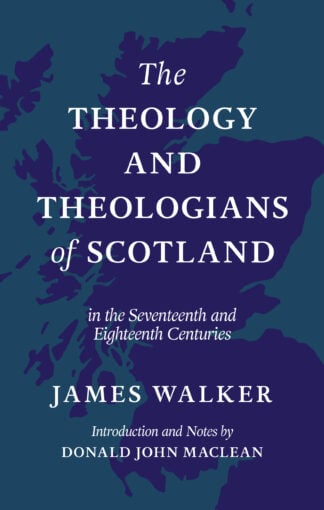
The Theology and Theologians of Scotland
in the Seventeenth and Eighteenth Centuries
Description
James Walker (1821–1891) belongs to that rare class of individuals who have been able to master the theological literature of a nation. This valuable book contains the fruit of his studies in the field of Scottish theology—a field rich with important topics of continued relevance. Originally delivered as a series of Cunningham Lectures at New […]
Featured Picture (visible when article shared online): Alexander Nasmyth, 1758–1840, View of the City of Edinburgh, ca. 1822, Oil on canvas, Yale Center for British Art, Paul Mellon Collection, B1974.3.21.
Latest Articles
Reading the Psalms: A New Resource 12 October 2026
As Christians we believe that all Scripture is God-breathed and useful for teaching, rebuking, correcting and training in righteousness so that the man of God may be thoroughly equipped for every good work (2 Tim. 3:16), but that doesn’t mean that there aren’t particular books and sections of Scripture that we love even more than […]
Pitfalls in Preaching: A Letter on Application 30 September 2026
The following letter was published in the December 2025 issue of the Banner Magazine. It is published here at the request of a reader who found it helpful, in the hope that its counsel might be blessed to others also. You can also listen to a reading of this letter on the Banner Podcast. Dear […]