
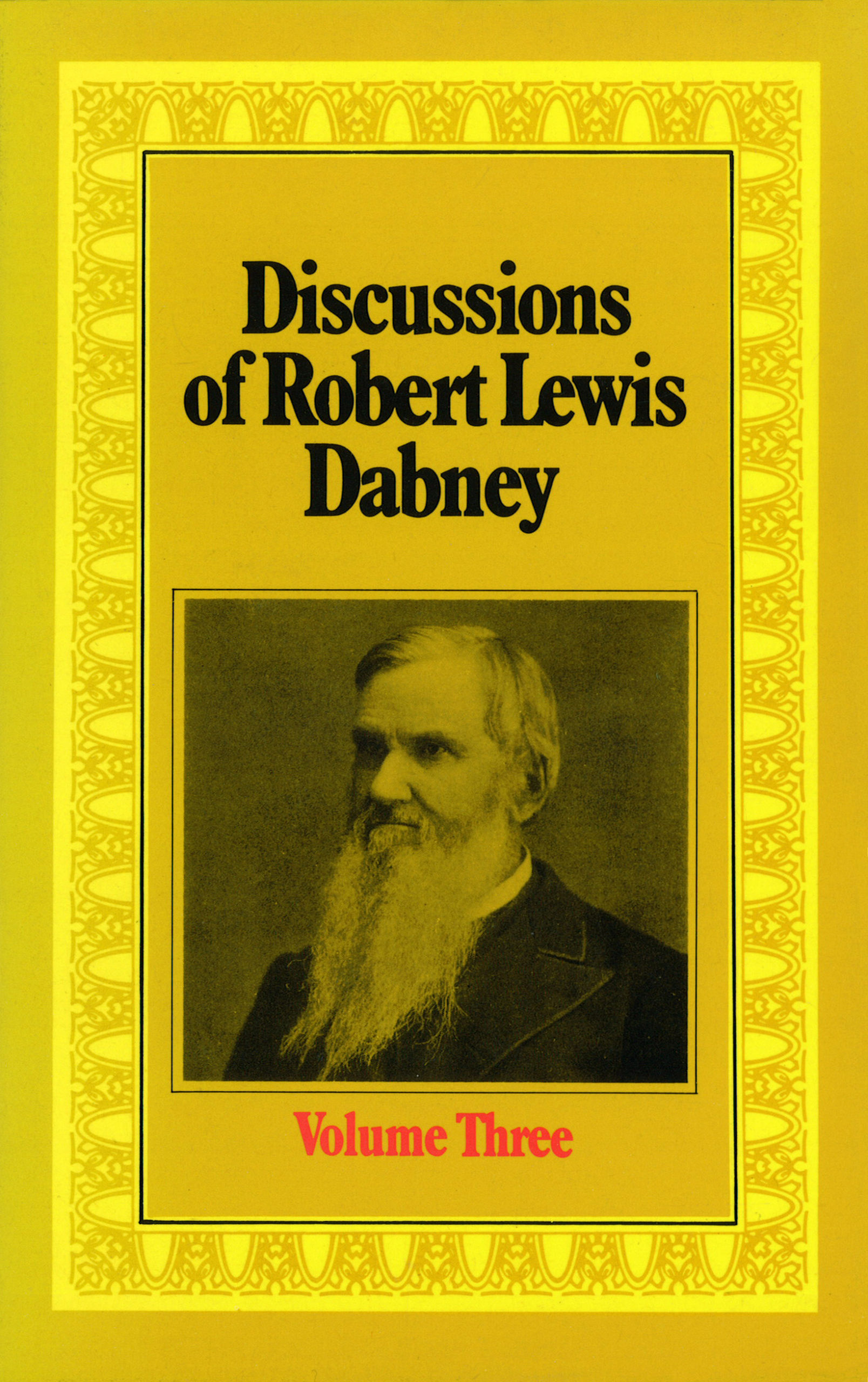
Discussions of R L Dabney
Volume 3
| Weight | 0.71 kg |
|---|---|
| Dimensions | 22.3 × 14.3 × 3.2 cm |
| ISBN | 9780851513508 |
| Binding | Cloth-bound |
| Format | Book |
| Page Count | 496 |
| Original Pub Date | 1892 |
| Banner Pub Date | Jan 1, 1982 |
ENDORSEMENT
‘R.L. Dabney was the most conspicuous figure and the leading theological guide of the Southern Presbyterian Church, the most prolific theological writer that Church has as yet produced, and for a period of over forty years one of the most distinguished and probably the most impressive teacher of its candidates for the ministry. As a preacher, as a teacher and as a writer equally he achieved greatness, and in the counsels of the State and of the Church alike he was a factor of importance. In the wider theological history of the country and of the epoch he finds a worthy place as one of the younger members of a remarkable company of theologians to whose lot it fell to reassert and reorganize the historical faith of the Reformed Churches in the face of the theological ferment which marked the earlier years of the Nineteenth Century.’
— B.B. WARFIELD
Book Description
Robert Dabney (1820-98), who was for forty years Professor in Union Seminary, Virginia, U.S.A., was in the opinion of Dr. Archibald Alexander, ‘the best teacher of theology in the United States, if not in the world’.
The third volume includes Dabney’s treatment of issues in society which are of perennial concern to the Church of Christ, including Anti-Christian Science, Secularized Education, Strikes and the influence of Roman Catholicism. A number of biographical sketches of great Christians whom Dabney knew also appear, including one of General T. J. (‘Stonewall’) Jackson, to whom Dabney had been Adjutant-General during the Civil War.
Table of Contents Expand ↓
| SPURIOUS RELIGIOUS EXCITEMENTS | 1 | |
| ANTI-BIBLICAL THEORIES OF RIGHTS | 21 | |
| THE STANDARD OF ORDINATION | 47 | |
| THE IMMORTALITY OF THE SOUL | 65 | |
| CIVIC ETHICS | 100 | |
| GEOLOGY AND THE BIBLE | 127 | |
| A CAUTION AGAINST ANTI-CHRISTIAN SCIENCE | 152 | |
| THE CAUTION ACAINST ANTI-CHRISTIAN SCIENCE CRITICISED BY DR. WOODROW | 173 | |
| MORALITY OF THE LEGAL PROFESSION | 217 | |
| THE STATE FREE SCHOOL SYSTEM IMPOSED UPON VIRGINIA BY THE UNDERWOOD CONSTITUTION | 238 | |
| SECULARIZED EDUCATION | 272 | |
| LABOR UNIONS, THE STRIKE AND THE COMMUNE | 295 | |
| NATURE CANNOT REVOLUTIONIZE NATURE | 322 | |
| LATEST INFIDELITY, A REPLY TO INGERSOLL’S POSITION | 328 | |
| THE ATTRACTIONS OF POPERY | 362 | |
| POPISH LITERATURE AND EDUCATION | 390 | |
| THE INFLUENCE OF FALSE PHILOSOPHIES UPON CHARACTER AND CONDUCT | 400 | |
| MEMOIRS OF FRANCIS S. SAMPSON, D.D. | 409 | |
| TRUE COURAGE. A MEMORIAL SERMON ON THE DEATH OF GENERAL T. J.JACKSON,JUNE, 1863 | 452 | |
| A MEMORIAL OF LIEUT. COL. JOHN T. THORNTON OF THE THIRD VIRGINIA CAVALRY, C.S.A | 470 | |
| INDEX | 487 |
Related products
Life & Sermons Of Edward D. Griffin
2 Volume Set
price
£29.00
Description
A biography of Griffin (1770–1837) by W.E. Sprague, with 60 of his sermons, which are fine examples of the simple, arresting and heart-searching preaching which was so used of God. 1192pp. Set.
The Works Of George Swinnock Volume 2
Volume 2: The Christian Man's Calling
price
£14.00
Description
Swinnock is one of the easiest Puritan authors to read. He is theological, yet his doctrine is expressed in vivid fashion. While practical, his counsel is marked by a keen sensitivity to scriptural doctrine. Approx. 520pp. per volume.
The Works Of George Swinnock Volume 4
Volume 4: LATTER PORTION OF THE FADING OF THE FLESH, THE PASTOR'S FAREWELL, THE GODS ARE MEN, THE BEAUTY OF MAGISTRACY, MEN ARE GODS, THE INCOMPARABLENESS OF GOD
price
£14.00
Description
Swinnock is one of the easiest Puritan authors to read. He is theological, yet his doctrine is expressed in vivid fashion. While practical, his counsel is marked by a keen sensitivity to scriptural doctrine. Approx. 520pp. per volume.
David P –
If Spurgeon was the Prince of Preachers, Dabney was the Paladin. While Dr. Dabney had a tendency to wax polemic, his lectures are eminently well-documented and heavily cited; Turretin, the Westminster Standards and of course the Scriptures. A must have for students of Southern Presbyterian history and Reformed theology.
Richard C Ross –
I’m not sure what I am to understand by Dabney being referred to as a ‘paladin’ to C. H. Spurgeon, when their positions on crucial matters of Christian theology and ethics were absolutely antithetical: see ‘The Full Harvest’, 99 & 124-126 and Spurgeon’s unmitigated condemnation of slave-holders in the letter of January 1860 to ‘The Christian Watchman and Reflector’, Boston. I stand with Spurgeon. Dabney’s ‘Discussions’ (all three volumes) may indeed be a ‘must for students of Southern Presbyterian history’ but surely only as a ‘cautionary tale’. Dabney is a dangerous author, largely on account of his magisterial ability to present arguments defending the most odious ecclesiastical and political principles with a devastating force of logic. Initially his arguments convince on account of his singular overwhelming rhetorical vigour. He was capable of battering an audience into silence by a colossal belligerence.
Yet, when his position, on any number of subjects, is weighed and assessed by a Berean principle – not public confrontation but private Scriptural contemplation – many arguments lose the force which berated his audience into stunned compliance.
I confess to being mystified by the commendations he received from men who command the highest respect. They give every impression of endorsing his entire output and so, one assumes, deliberately turned the blind eye to colossal defects which marred so much excellence.
Dabney was capable of acting as a belligerent intellectual thug. A quality of his personality most fully exposed in his odious diatribe against black members of the body of Christ enjoying their spiritual birthright. (I refrain from quoting any part of Dabney’s writing on the subject – including his ‘Speech Against the Ecclesiastical Equality of Negros and Their Right to Rule Over White Christians’ – as to do so could be deemed illegal in the UK.) While ‘a little leaven leavens the whole lump’, this lump of leaven leavens the entire bakery. Dabney’s repellent contribution to this fundamental aspect of ecclesiastical polity is directly and intensely relevant; his writings (and those of Thornwell) provide intellectual fodder for advocates of the most abhorrent attitudes and behaviour, philosophies and theologies of various contemporary religious and political movements in the USA and the UK. ‘Now I beseech you, brethren, mark them which cause divisions and offences contrary to the doctrine which ye have learned; and avoid them’. (Romans 16.17)
I realise, of course, my remarks will appear outrageous. My defence is simply to request you read the whole ‘Speech…’ to which I made reference.